Techniques
-
An Atheopagan Table of Correspondences
In many of the Pagan books circulating out there, a large chunk of the pages are devoted to “tables of correspondences”. These tables identify particular herbs, gems and minerals, incense scents, foods, and other materials with particular emotions, life experiences, times of year, and so forth. Well, I didn’t want Atheopagans to be left out on this sort of thing, so I’ve rigorously compiled the Atheopagan Table of Correspondences below from the great dusty volumes of the Atheopagan Book of Shadows that reside on my Focus. Enjoy! 😀 Material Correspondences Color (any): Whatever you…
-
Ritual “Special Effects”
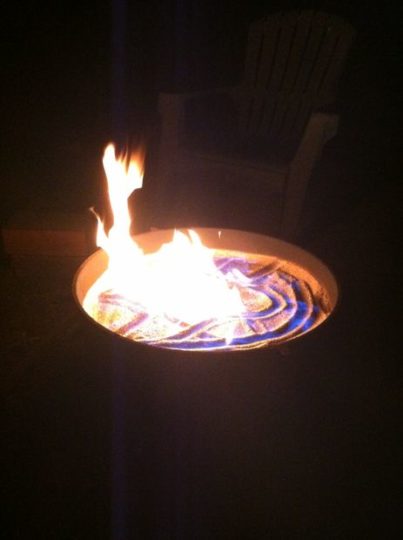
Sometimes in a ritual, a little special-effects magic can help to create that sense that “magic is happening”. Here are some effects I’ve collected from a conversation in the Atheopagan Facebook group. Burning Isopropyl alcohol. Use the full 90%+ stuff, not the 40% methanol “rubbing alcohol”. This is highly flammable and can make for a marvelous ritual effect. I have a shallow basin on a dragon-shaped pedestal that works perfectly for this. When you light it, it flares up beautifully and burns for a few minutes; if you want for it to last longer, put epsom salts in the bottom of your burning basin, which will absorb the alcohol and release…
-
Loving the World: An Atheopagan Sex Magic Primer for May Day (NSFW)
CONTENT WARNING: This post contains frank discussion of sexuality, and is meant for adults. If you’re not one, please stop reading and go elsewhere. … … … … … … … … Loving the World: An Atheopagan Sex Magic Primer for May Day (NSFW) Spring is often thought of as the season of sex. Trees and plants are flowering, birds are nesting, and the weather finally warms up enough that people wear less clothing and thoughts turn to desire. It’s now April, coming up on May Day, which is the Sabbath celebration the metaphorical meanings of which include sexuality, attainment of adulthood and celebration of sensual pleasures. This is a time-honored…
-
Journeying in the Inner Landscape
Here at Atheopaganism, we have discussed ritual skills quite a bit. Developing the skill sets that help people to attain the Ritual State (or “trance”) is key to our ability to be effective ritualists who can transform consciousness in empowering ways. Click here to see previous posts tagged as “Ritual Technologies and Core Skills”. Thus far, these posts have been about using skills and technologies to induce the Ritual State. But today we turn to another question: what to do once you get there? Trance is powerful, and can be experienced simply as a glowing, liminal state within which to conduct ceremonial activities or contemplation…or it can be the context…
-
Giving Voice: Public Speaking as a Core Ritual Skill
Speaking before an audience is terrifying for many people. In fact, surveys indicate that many fear public speaking more than death itself. However, for ritualists, speaking confidently before a group of listeners is a core skill that enables clear communication, evocation of emotion, and establishment of leadership credibility which provokes a sense of safety and confidence in the ritual proceedings on the part of participants. As a ritual leader—and remember, in Atheopaganism there is no priesthood, anyone can be a ritual leader—your spoken voice is perhaps your most powerful tool for moving participants into ritual space and common purpose. As a participant, it is sure to be called upon at…
-
What Makes a Ritual “Successful”?
John Halstead over at Humanistic Paganism has published a rather sharply-worded piece about “10 Signs You’re Half-Assing Your Ritual”. It’s well worth a read, and in general, he’s right: there is a lot of ho-hum ritual out there and many, if not most of us can do a better job of preparing and enacting our rites. But I think there is something missing in John’s piece, and that is this: a discussion of what we mean by a “successful” ritual. This is often a moving target. When you talk to someone who has come out of a successful ritual, more often than not what they will talk about is not…
-
Ritual Technologies: Movement
Since probably before humans were even human, there has been music. Rhythm, at least. And where there is rhythm, there is dance. There are preserved footprints in painted caves in France that indicate young boys dancing 20-30,000 years ago. Some ritual dances are still performed today after untold continuous centuries. Ritual isn’t just something that happens in our heads. When effective, it is an immersive experience, involving our entire beings. We are not, after all, just brains carried by flesh robots…our nervous systems extend throughout our bodies and participate heavily in our brain states. Effective rituals involve some kind of engagement of the body: singing, for example, or clapping, dancing, walking, or other movement…
-
Ritual Technologies: Scent
As I’ve mentioned before, the most powerfully evocative of the human senses is the sense of smell. The olfactory centers are in the most primitive parts of the brain, and they can summon vivid memories in an instant, simply from a remembered scent. For thousands of years, people have burned incense and aromatic herbs such as sage, yerba santa and sweet grass to alter the mood and atmosphere around them. They have daubed themselves with perfumes and oils, brought bouquets of aromatic flowers into their homes and temples, and scattered flowers over their dead. Indeed, we have evidence of flowers in burials of Neanderthals from 60,000 years ago; whether this was because they…
-
Ritual Technologies: Rhythm
The first musical instrument was almost certainly something resonant being struck: a hollow log, a dried gourd. In fact, percussive rhythm may predate humans as a species: monkeys have been observed beating on hollow logs in a call-and-response with other monkeys. Certainly the noises made while pounding seeds and roots into meal would naturally have become a source of play, even for pre-humans. Despite this near-certainty, we don’t have any fossil evidence of Paleolithic drums. Only flutes, because they were made of bone and could survive. Still, in every culture of the world, we find percussive instruments, and with them, percussive play—often in a context of religious ceremony. Drumming and…
-
Developing a Focus
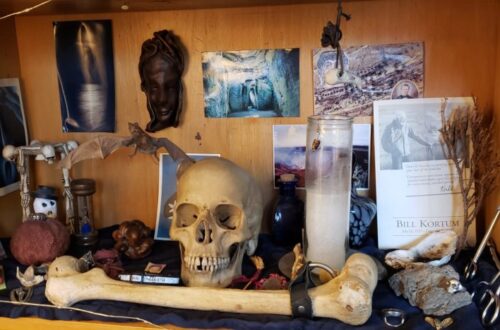
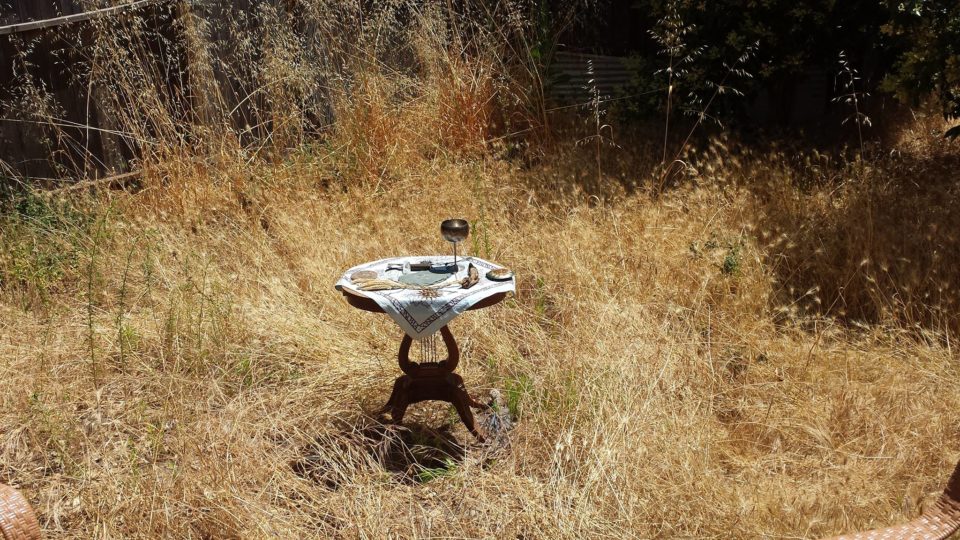
A Focus is an Atheopagan word for an altar. I use this word because “altar” seems to me to imply worship and/or sacrifice, neither of which are components of my religion. The Focus is: A curated collection of meaningful objects gathered together for ritual use and placed upon one or more surfaces in an intentional pattern. These objects may be of practical use in a ritual, or chosen solely for their symbolic meaning to the person or people creating the Focus. A Focus may be built anywhere with horizontal surfaces on which to place the objects: a shelf, a table, a mantle, a tree stump, or simply the ground. Often, the…