-
What’s This Atheopaganism About, Exactly?
So, we’re doing this Atheopaganism thing. What’s its purpose? What are its goals? I think we talk around the edges of this question a lot, with discussions of Sacred values and Principles that clearly point their way to a vision. But it would be better to articulate that vision straight-out, so people are clear about where I come from, and so we can discuss and refine it if it doesn’t work for the Atheopagan community writ large. My vision for Atheopaganism is a nested set of Russian matryoshka. It exists on scales from the personal to the societal. Personally, I pursue my Atheopagan practice as a modality for healing my inner wounds,…
You May Also Like
The Point of Friction

The Unthinkable

FACING FORWARD: A talk on nontheist Paganism
-
Giving Voice: Public Speaking as a Core Ritual Skill
Speaking before an audience is terrifying for many people. In fact, surveys indicate that many fear public speaking more than death itself. However, for ritualists, speaking confidently before a group of listeners is a core skill that enables clear communication, evocation of emotion, and establishment of leadership credibility which provokes a sense of safety and confidence in the ritual proceedings on the part of participants. As a ritual leader—and remember, in Atheopaganism there is no priesthood, anyone can be a ritual leader—your spoken voice is perhaps your most powerful tool for moving participants into ritual space and common purpose. As a participant, it is sure to be called upon at…
-
What Makes a Ritual “Successful”?
John Halstead over at Humanistic Paganism has published a rather sharply-worded piece about “10 Signs You’re Half-Assing Your Ritual”. It’s well worth a read, and in general, he’s right: there is a lot of ho-hum ritual out there and many, if not most of us can do a better job of preparing and enacting our rites. But I think there is something missing in John’s piece, and that is this: a discussion of what we mean by a “successful” ritual. This is often a moving target. When you talk to someone who has come out of a successful ritual, more often than not what they will talk about is not…
-
Why Atheopagan Principles?
I am excited to announce that a new Facebook group has arisen for Atheopagans in the UK! Congratulations to Debi Gregory for starting the group. Those applying to join the group are asked to answer a short questionnaire, which originally asked for a commitment to abide by the 13 Atheopagan Principles. Some were puzzled by this, or felt they are too restrictive. So I thought I would unpack the issue a bit and discuss why ethical principles are a necessary part of a functioning religion. Obviously, everyone has their own moral compass. We act according to what we view as right and proper; even when we are breaking our own…
-
After the Fire
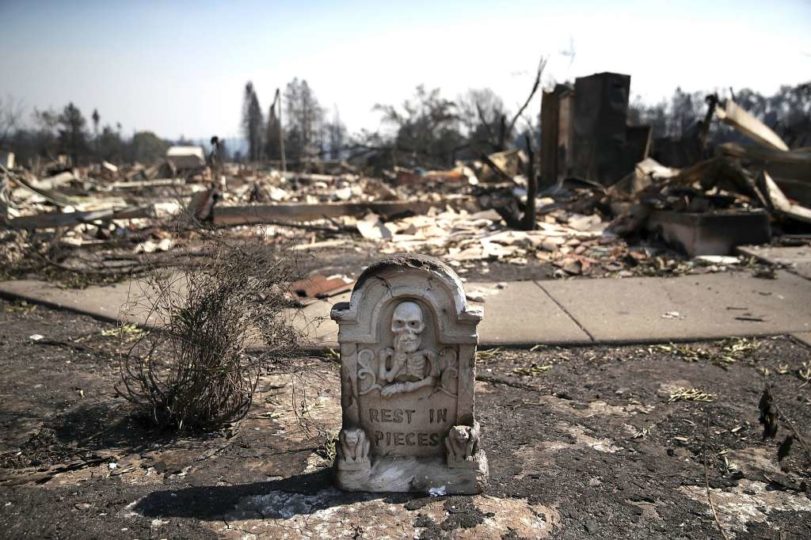
It isn’t really over, of course. Two dozen have lost their lives. Thousands are without homes, their possessions rendered to gray ashes. The most vulnerable among them–renters, the uninsured–will almost certainly flee our expensive region, despite admirable community efforts to raise funds to support them. The acrid smell of burned lives lingers in the air, and driving past the devastation is still like a bad dream. On and on it goes: the gray, burned wreckage, the burned-out cars. That said, people are getting on with it, as they must. The ground floor of our local daily newspaper has been let out as a disaster center with representatives of dozens of…
-
The Elemental Enemy
My sacred places are burning. Sonoma County, heart of my heart, is on fire, and its magnificent wildlands, its rolling oak woodland hills and grasslands are steadily being destroyed. Annadel and Sugarloaf Ridge State Parks, where I have lost myself in a steady wash of serotonin joy at the sheer beauty, the wildness, the richness of creation, are aflame; Annadel is mostly gone now. It’s hard even to get my mind—much less my visceral understanding—around this fact. Things are moving quickly and every day of the past five has brought new alerts, new evacuation orders. The fire that dislodged me from my home stabbed deep into my home town of…
-
Dark Hallows
Hallows is unique among Atheopagan Sabbaths. For one thing, it’s a week long: it extends from Halloween through the actual midpoint between the autumnal equinox and the winter solstice, which falls around the 7th of November. A whole week of observances, of rituals, of spooky-eerie awareness of Death, of Ancestry, of the Dark. As it happens, where I live, the transition from Daylight Savings Time to Standard Time happens on the first weekend in November, so there is a sudden plunge into night as the clocks roll back an hour and sunset is suddenly an hour earlier. It doesn’t take imagination to realize that the Darkness has arrived. And let’s…
-
Turns Out, I’ve Been Living in an Atheopagan Focus
A guest post by Kaigi-Ron. It was the knives that first pointed me to the truth. Seven of them stood at attention by my sink (fastened in magnetic rigor by the new strip I’d just installed), adjacent to the Hello Kitty curtains. And I was struck: OMG, I have a living Housewives Tarot card in my kitchen! What was weirdest, this didn’t seem random: I had recently been the victim of vicious (and untrue) gossip. Yet My Science Nerd Mind knew that there was no way this was “directed” at me by “somebody else”. I pulled the HWT deck from the shelf, found the Seven of Swords, and re-read the copy: GOSSIPS…
-
Autumn
In the coastal Mediterranean climate where I live, September and October are times of hot days and clear, cold nights. The sun is no longer strong enough—nor are the days long enough—to drive the cycle that draws ocean air inland during the height of summer, blanketing us with cooling fog. It is a somewhat eerie time, typically windless, with wan sunlight and hard blue skies as leaves turn, children return to school and adults to work after the playful season of summer. The scent of fermenting grapes often fills the air as “The Crush” of the grape harvest proceeds and the vineyards turn autumn colors. Summer gardens crank out vegetables…
-
Why Naturalism? Because This.
Yet another example of a Pagan in a leadership position using that position for sexual misconduct, citing woo-woo “spiritual” reasons involving disembodied entities and “magical bonds” as “explanations” for his abuse. How far would such hokum fly in a naturalistic Pagan community? Not. At all. Willingness to take someone’s word about supposed supernatural processes and invisible beings is a formula for being abused. Healthy skepticism would have tossed this creep out on his ear long ago, but the conventions of many Pagan communities which take at face value highly improbable assertions about the nature of reality create safe contexts within which abusers can operate. Say what you like about naturalistic…